History
We are proud of our long tradition and eventful history as a family-owned company from the heart of Germany’s Ruhr region. The present-day Wilo Group emerged from the “Louis Opländer Copper and Brass Goods Factory,” founded in Dortmund in 1872. Two principles have always shaped who we are: continuity and adaptability. These values are reflected in our corporate culture, our commitment to taking responsibility for our employees, our dedication to developing resource-efficient technologies, our purposeful pioneering spirit, and our constant drive to improve.
Tradition and innovation since 1872
Over the course of five generations, the Wilo brand has developed into a multinational water technology group. Forward-looking decisions have contributed to our long-term strategic direction and business success. A significant step in securing our future was the appointment of Oliver Hermes as the entrepreneurial successor to Dr.-Ing. E.h. Jochen Opländer in 2018. Since 2006, Oliver Hermes, as President & Global CEO, has consistently driven the transformation of the Wilo Group forward.

Globally connected, locally rooted
Wilo is represented worldwide through 90 production and sales companies in numerous countries and continues to expand. The internationalization process began in 1967 with expansion into Belgium. Many other countries followed, including France, the United Kingdom, and Italy in the mid-1980s. In 2000, an important step in developing the Asian market was taken with the establishment of the Korean subsidiary Wilo-LG Pumps Ltd.
In 2003, we expanded our product portfolio through the acquisition of the EMU Group, adding submersible pumps. Further acquisitions followed in India and the United Kingdom. Today, Wilo operates 16 main production sites in several regions worldwide. In addition to the Group headquarters and Europe headquarters in Dortmund, two further regional headquarters were opened in Dubai (UAE) and Chicago (USA) in 2025 as part of a realignment of the Wilo Group. The “region-for-region” approach is intended to support regional value creation structures and shorter coordination paths. International, cosmopolitan, and grounded – we are a global group while remaining aware of our roots.
Internationalisation and growth
As CEO, Oliver Hermes strengthened Wilo’s international position through market entry in East-West-Central Africa and Latin America, as well as by expanding the company’s presence in Southeast Asia and the Middle East. Under his leadership, new plants were built in India, China, South Korea, Türkiye, the United Arab Emirates, and the USA, contributing to the Group’s development into a company with annual revenues in the billion-euro range in recent years.

Innovative by tradition
Wilo has helped shape the development of pump technologies over many decades – from the circulator accelerator launched in 1928 to today’s high-efficiency pumps. Today, we offer services for a wide range of water technology applications. We use digital and AI-based applications to support users in managing water technology systems. Our aim is to design water technology applications with users’ needs in mind.
From Dortmund to the world
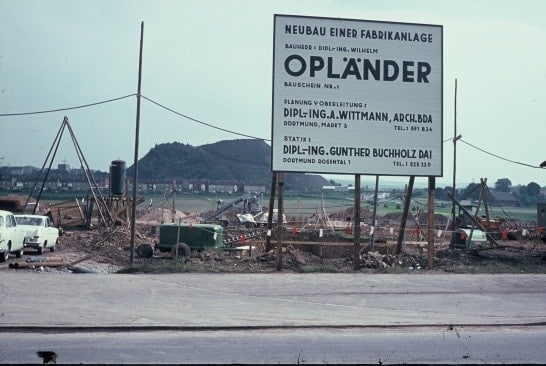
When Caspar Ludwig, known as Louis, Opländer founded the company in Dortmund in 1872 as a copper and brass goods factory, it initially produced distillation systems for the beverage industry. In doing so, he laid the foundation for today’s Wilo Group. What followed was the company’s development over the decades, helping position Wilo as an innovation-oriented company in pump and water technology.
Wilo now looks back on more than 150 years of company history. During this time, the company has established an international presence. Innovation and technical development have been recurring themes throughout our history – from steam heaters and hot water heating systems to smart solutions, and from the Louis Opländer copper and brass goods factory to the Wilo Group.


