Louis Opländer

The Producer
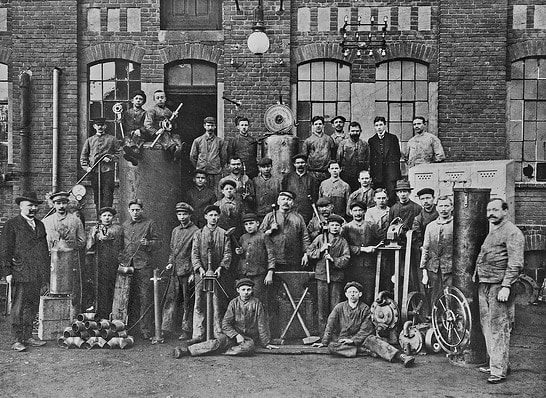
Workforce and products of the Louis Opländer company with a barrel measuring device (right), two dust extraction systems with transmission drive (to the left of it), and a fire extinguisher (rear center), around 1910.
In undoubtedly difficult times and after a childhood marked by hardship, Louis took over the profession of his father, Caspar Ludwig Opländer, at a young age and further developed technical solutions for additional fields of life and application, such as heating, ventilation, and sanitation. In doing so, it became clear that his early experience in the family workshop had taught him to think in complex systems.
This enabled him to transfer technical solutions into broader application areas. For example, in Dortmund’s heavy industry, systems of considerable scale were built: on the one hand for heating and ventilating the miners’ washhouses, and on the other hand to meet the substantial technical demands of those facilities themselves. Thousands of miners required large quantities of water at the right temperature for washing and showering after work. For their time, these systems represented technically demanding solutions.
Louis was an engineer in the fullest sense, with a strong sense of professional responsibility and a clear ambition to develop technical solutions for the living and working conditions of his time. His technical planning was consistently accompanied by the aim of improving technical processes and people’s quality of life.
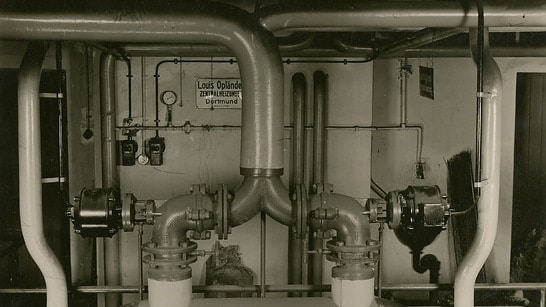
Stove heating systems were replaced by central heating systems.
His systems and apparatus were designed to meet the technical requirements of their respective applications while also enabling operation that was as efficient as possible. According to historical sources, efficiency at the time was also assessed on the basis of energy demand. His exceptional inventive spirit and powers of understanding enabled him to recognize the great need for innovation and to develop technical solutions for new challenges in an entrepreneurial way. Industrialization rapidly created major challenges in providing accommodation for large numbers of workers moving into newly built housing.
At that time, such housing was built in the simplest construction style, with brick masonry, no wall insulation, and windows and doors that were not tightly sealed. Heating was provided by the kitchen stove or a room stove fired with coal. While the room stove supplied the desired warmth, the resulting dust and fumes were unwanted side effects. Multi-storey buildings often had only a single chimney, into which smoke gases from each floor were directed, which could lead to a greater exposure to fumes on the upper floors. As an engineer, Louis set himself the goal of technically reducing the burden caused by the stove heating systems of the time, with his main objective being to replace them with central heating.
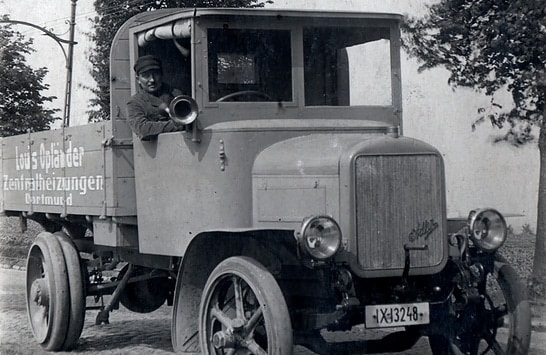
Vehicle of the Louis Opländer company. Louis Opländer, Central Heating Systems Dortmund
Steam central heating already existed to a certain extent, but according to the technical standards of the time it had limitations in terms of residential comfort.
Hot-water gravity heating was one approach to improving heat supply at the time, although at first this was only successful in smaller systems. The hot-water heating approach was subsequently developed further in order to achieve as even a heat distribution as possible. With the development and manufacture of steam and hot-water heating systems, the company “Louis Opländer” became increasingly established in the field of central heating engineering. The life’s work of the manufacturer Louis Opländer includes numerous technical developments, among them, shortly after the turn of the century, the barrel measuring machine.
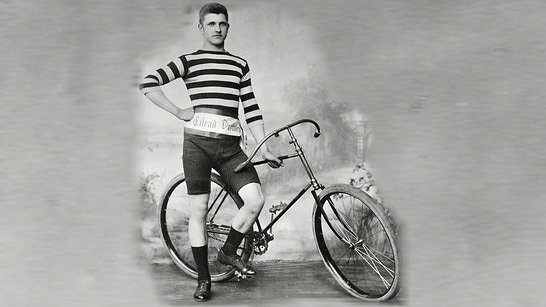
Louis Opländer in the jersey of the cycling club “Eilrad Dortmund”
In his private life as well, the manufacturer Louis Opländer was open to new developments. He was enthusiastic about sport, whether racing bicycles in the 1880s, skiing, which had just become fashionable at the time, or rowing. He witnessed the opening of the Dortmund-Ems Canal in 1898, which strengthened his enthusiasm for rowing, and became a co-founder of Ruderclub Hansa e.V. in Dortmund. Contemporary sources also show the importance that fairness held for Louis Opländer, including in his business conduct.


